rcs_no2 <- run_rcs(
  data = analysis_data,
  exposure = "no2_main",
  covariates = c("age", "sex", "tdi", "ethnicity", "education", "smoking", "drinking"),
  model_type = "cox",
  endpoint = c("outcome_surv_time", "outcome_status"),
  backend = "rms",
  knots = 4
)

rcs_no2$p_overall
rcs_no2$p_nonlinear

plot_rcs(
  rcs_no2,
  xlab = "NO2",
  ylab = "HR for incident arrhythmia"
)Advanced analysis
This chapter summarizes the advanced statistical modules in UKBAnalytica. These functions are intended for common epidemiological extensions after the main regression analyses: restricted cubic spline analysis, subgroup analysis, propensity score analysis, and causal mediation analysis.
Module overview
| Analysis task | Main functions | Typical use |
|---|---|---|
| Restricted cubic spline analysis | run_rcs(), plot_rcs() |
Visualize nonlinear dose-response relationships for continuous exposures |
| Subgroup analysis | run_subgroup_analysis(), run_multi_subgroup() |
Estimate effects within strata and report interaction p-values |
| Propensity score analysis | estimate_propensity_score(), match_propensity(), calculate_weights(), run_weighted_analysis() |
Reduce confounding in observational treatment or exposure comparisons |
| Mediation analysis | run_mediation(), run_multi_mediator() |
Decompose total effects into direct and indirect pathways |
For multiple imputation workflows, see the Multiple imputation chapter.
Restricted cubic spline analysis
Restricted cubic spline (RCS) analysis is used to inspect whether a continuous exposure has a linear, threshold-like, U-shaped, or otherwise nonlinear association with an outcome. This is useful for air pollutants, biomarkers, proteins, metabolites, and clinical measurements where categorizing the exposure would discard information.
UKBAnalytica provides two functions:
run_rcs()fits the spline model and returns prediction data, 95% confidence intervals, the reference value, the knot count, the overall P value, and the nonlinear P value.plot_rcs()visualizes the curve with a confidence ribbon, null reference line, reference point, optional exposure distribution, and P-value annotation.
The function supports three model families:
model_type |
Outcome type | Effect scale |
|---|---|---|
"cox" |
Time-to-event outcome | Hazard ratio (HR) |
"logistic" |
Binary outcome | Odds ratio (OR) |
"linear" |
Continuous outcome | Mean difference |
Two backends are available. backend = "rms" uses rms::rcs() and is the recommended option for manuscript-style RCS analysis. backend = "ns" uses splines::ns() as a lightweight fallback that requires no additional RCS package dependency.
Cox RCS for time-to-event outcomes
The example below evaluates the nonlinear association between NO2 and incident arrhythmia using a Cox model. The y-axis is the hazard ratio relative to the reference NO2 value, usually the median.
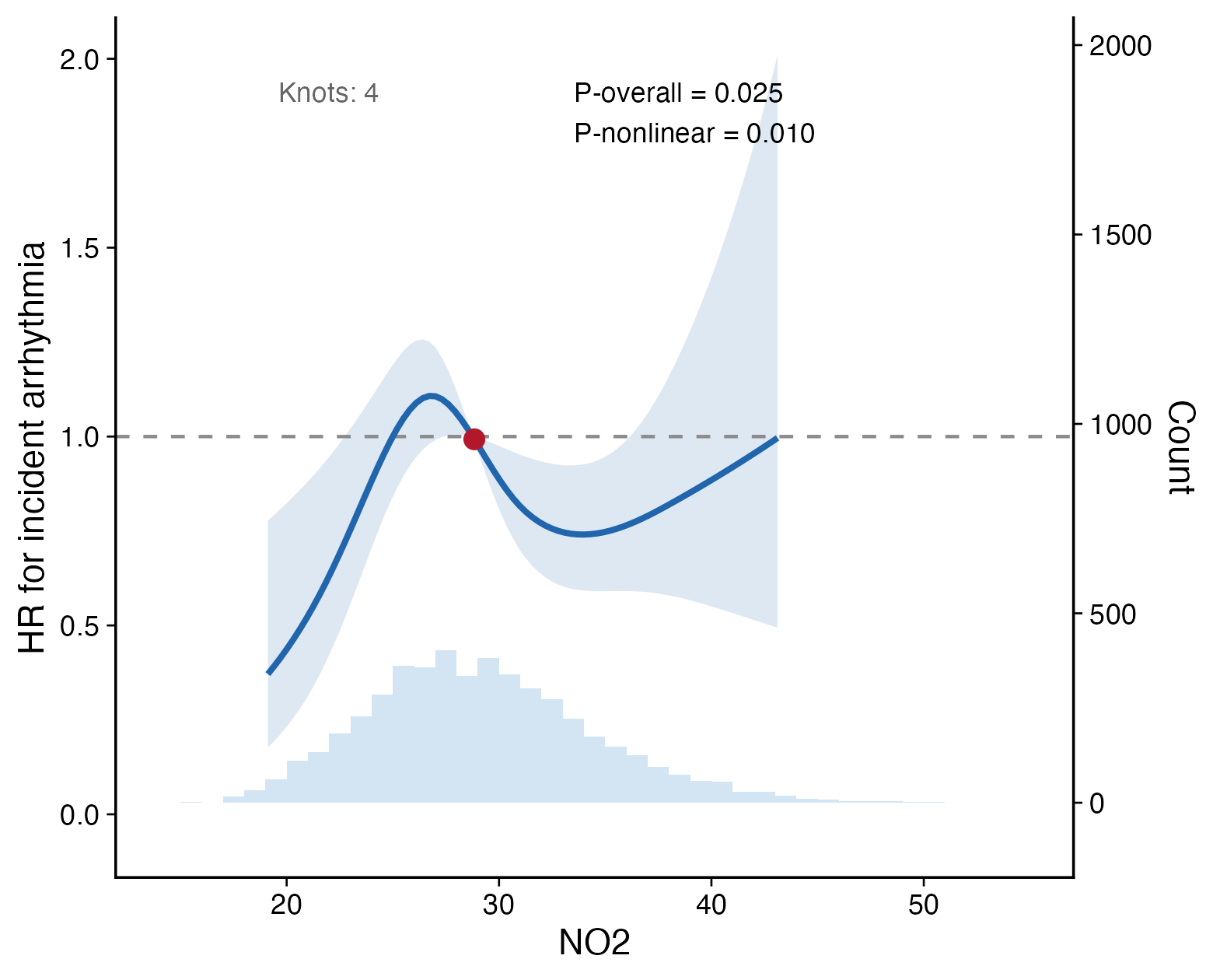
The solid curve is the estimated HR, and the shaded band is the 95% confidence interval. The dashed horizontal line indicates HR = 1. P-overall tests whether the exposure is associated with the outcome, while P-nonlinear tests whether the exposure-response shape deviates from linearity.
Logistic RCS for binary outcomes
For a binary endpoint, set model_type = "logistic" and provide outcome. The y-axis is an odds ratio relative to the reference exposure value.
rcs_pm25 <- run_rcs(
  data = analysis_data,
  exposure = "pm25",
  covariates = c("age", "sex", "tdi"),
  model_type = "logistic",
  outcome = "outcome_status",
  backend = "ns",
  knots = 4
)

plot_rcs(
  rcs_pm25,
  distribution = "density",
  xlab = "PM2.5",
  ylab = "OR for incident arrhythmia"
)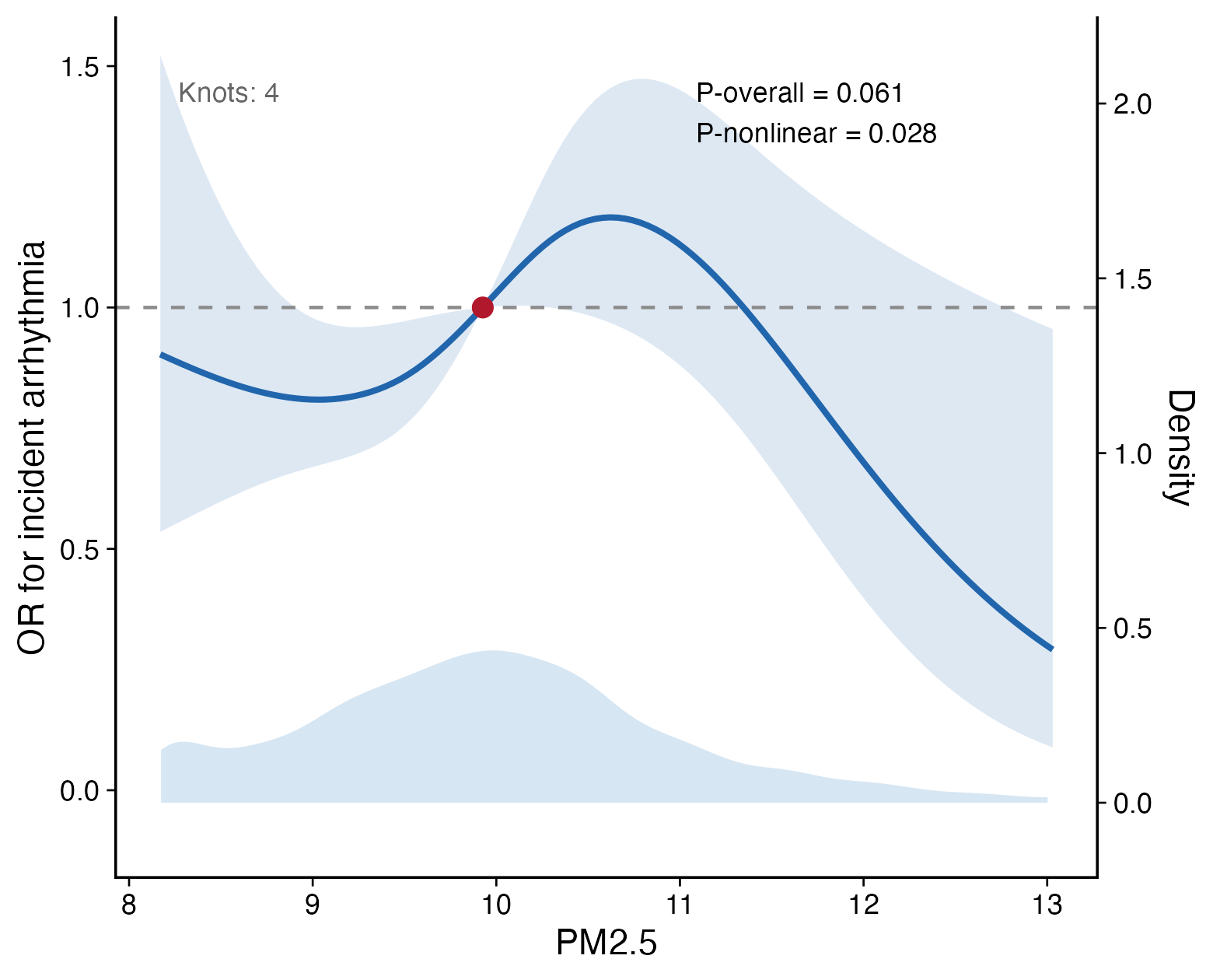
This model ignores follow-up time and treats the outcome as a binary status, so it is best suited to cross-sectional or fixed-window binary outcomes.
Linear RCS for continuous outcomes
For continuous outcomes, set model_type = "linear". The curve shows the difference in the outcome relative to the reference exposure value.
rcs_nox_bmi <- run_rcs(
  data = analysis_data,
  exposure = "nox",
  covariates = c("age", "sex", "tdi"),
  model_type = "linear",
  outcome = "bmi",
  backend = "ns",
  knots = 4
)

plot_rcs(
  rcs_nox_bmi,
  distribution = "rug",
  xlab = "NOx",
  ylab = "Difference in BMI"
)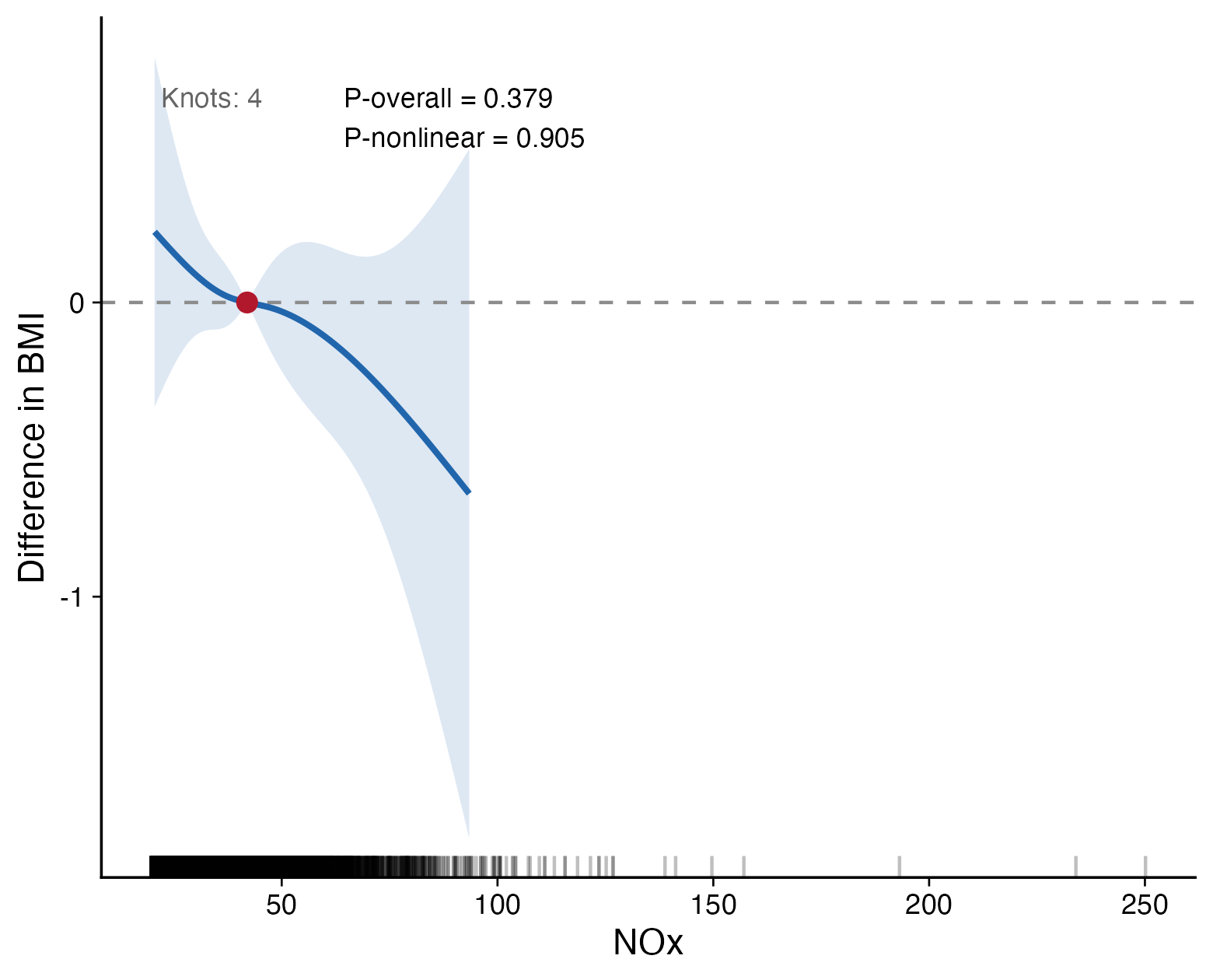
When the curve stays close to zero and the nonlinear P value is not significant, there is little evidence for a nonlinear exposure-response relationship.
Practical notes for RCS
- Prefer continuous exposures on their original scale unless a transformation is clinically meaningful.
- Avoid interpreting unstable tails when few participants are exposed at the extremes;
trim_quantiles = c(0.01, 0.99)is used by default. - Report the reference value, knot count, overall P value, nonlinear P value, adjustment covariates, and model family.
- Use
backend = "rms"for formal manuscript analyses when thermspackage is available; usebackend = "ns"for lightweight examples and smoke tests.
Subgroup analysis
run_subgroup_analysis() estimates an interaction p-value from a full model containing an exposure-by-subgroup term, then refits separate models within each subgroup level and returns a harmonised table of effect estimates, confidence intervals, and interaction statistics.
Five model families are supported via the model_type argument:
model_type |
Fitting function | Effect estimate |
|---|---|---|
"cox" |
survival::coxph() |
Hazard ratio (HR) |
"logistic" |
stats::glm(binomial) |
Odds ratio (OR) |
"linear" |
stats::lm() |
Beta (mean difference) |
"glm" |
stats::glm(family) |
Ratio (log/logit link) or beta (identity) |
"negbin" |
MASS::glm.nb() |
Incidence rate ratio (IRR) |
Time-to-event outcome
subgroup_res <- run_subgroup_analysis(
  data       = survival_data,
  exposure   = "smoking_status",
  subgroup_var = "sex",
  model_type = "cox",
  endpoint   = c("follow_up_time", "incident_status"),
  covariates = c("age", "bmi", "ethnic")
)

subgroup_res
Count outcome (Poisson GLM)
Use model_type = "glm" with family = "poisson" for count outcomes. The estimate column returns the incidence rate ratio (exp(beta)) when the family uses a log link.
subgroup_glm <- run_subgroup_analysis(
  data         = analysis_data,
  exposure     = "smoking_status",
  outcome      = "hospitalisation_count",
  subgroup_var = "sex",
  model_type   = "glm",
  family       = "poisson",
  covariates   = c("age", "bmi", "ethnic")
)
For overdispersed count outcomes, substitute model_type = "negbin" (no family argument required).
subgroup_nb <- run_subgroup_analysis(
  data         = analysis_data,
  exposure     = "smoking_status",
  outcome      = "hospitalisation_count",
  subgroup_var = "sex",
  model_type   = "negbin",
  covariates   = c("age", "bmi", "ethnic")
)
# estimate column = IRR = exp(beta); theta (dispersion) is reported per model
Multiple subgroup variables
For multiple subgroup variables, use run_multi_subgroup() and visualize the result with plot_forest().
subgroup_all <- run_multi_subgroup(
  data         = analysis_data,
  exposure     = "smoking_status",
  subgroup_vars = c("sex", "age_group", "bmi_group"),
  model_type   = "cox",
  endpoint     = c("follow_up_time", "incident_status"),
  covariates   = c("age", "bmi", "ethnic")
)

plot_forest(
  subgroup_all,
  estimate_col = "estimate",
  lower_col    = "lower95",
  upper_col    = "upper95",
  null_value   = 1,
  log_scale    = TRUE
)
The same model_type and family arguments apply to run_multi_subgroup().
Interaction p-value notes
- For single-level binary subgroups the interaction p-value comes from the Wald test on the single interaction coefficient.
- For multi-level factors a likelihood-ratio test (LRT) is used: the full model with all interaction terms is compared against the main-effects model via
stats::anova(). Quasi-likelihood families fall back to an F-test. - When the exposure has no variation within a subgroup level, the function returns
NAfor the effect estimate and issues a warning rather than stopping.
Propensity score analysis
Propensity score methods can be used when comparing an exposure or treatment group in observational data. The workflow is: estimate propensity scores, perform matching or weighting, then fit the outcome model.
ps_data <- estimate_propensity_score(
  data = analysis_data,
  treatment = "exposure_group",
  covariates = c("age", "sex", "bmi", "smoking_status", "ethnic"),
  method = "logistic"
)

matched_data <- match_propensity(
  data = ps_data,
  treatment = "exposure_group",
  ps_col = "ps",
  ratio = 1,
  caliper = 0.20
)
For IPTW analyses, use calculate_weights() followed by run_weighted_analysis().
weighted_data <- calculate_weights(
  data = ps_data,
  treatment = "exposure_group",
  ps_col = "ps",
  weight_type = "ATE",
  stabilized = TRUE
)

weighted_res <- run_weighted_analysis(
  data = weighted_data,
  exposure = "exposure_group",
  model_type = "cox",
  endpoint = c("follow_up_time", "incident_status"),
  weight_col = "weight"
)

weighted_res
Mediation analysis
run_mediation() wraps regression-based mediation analysis and supports linear, logistic, and Cox outcomes. It is useful when testing whether an exposure effect is partly explained through an intermediate variable.
med_res <- run_mediation(
  data = analysis_data,
  exposure = "smoking_status",
  mediator = "inflammatory_marker",
  outcome = "follow_up_time",
  outcome_type = "cox",
  endpoint = c("follow_up_time", "incident_status"),
  mediator_type = "continuous",
  covariates = c("age", "sex", "bmi", "ethnic"),
  exposure_levels = c(0, 1),
  boot = TRUE,
  boot_n = 1000
)

summary(med_res)
For screening several candidate mediators, use run_multi_mediator().
multi_med <- run_multi_mediator(
  data = analysis_data,
  exposure = "smoking_status",
  mediators = c("bmi", "crp", "hba1c"),
  outcome = "follow_up_time",
  outcome_type = "cox",
  endpoint = c("follow_up_time", "incident_status"),
  covariates = c("age", "sex", "ethnic")
)

multi_med
Practical notes
- Keep the adjustment set consistent with the main analysis unless the advanced analysis has a specific causal estimand.
- Check subgroup sample sizes and event counts before interpreting interaction p-values.
- Inspect propensity score overlap and covariate balance before reporting matching or weighting results.
- For mediation analysis, define the temporal and biological ordering of exposure, mediator, and outcome before model fitting.